Why do animals freeze when danger threatens? This question has long intrigued me. Recently, in the shimmering heat of the Dhofar Desert in Oman, the answer suddenly came alive again: An Arabian gazelle appeared before me.
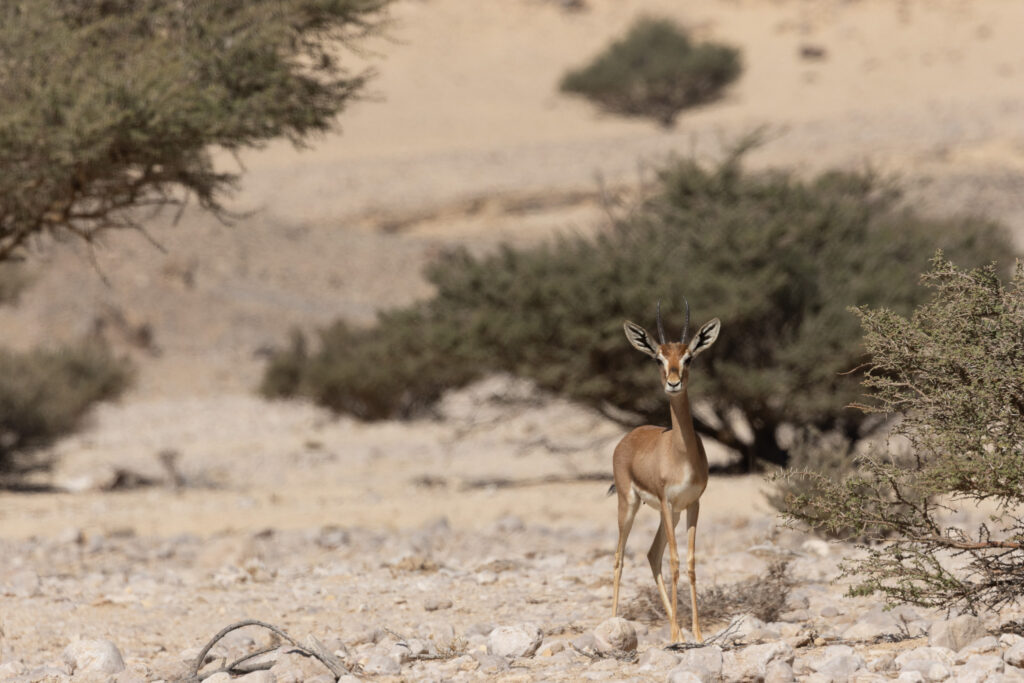
In a landscape where gazelles are extremely rare and shy, this was a special moment. She noticed me, held my gaze, and remained still. Her eyes fixed on me, motionless, yet full of anticipation. No panicked reflex, no passive waiting, but pure, watchful presence. Every fiber of her being was taut, every detail in her sight, until the decision was made: to act now or to stay.
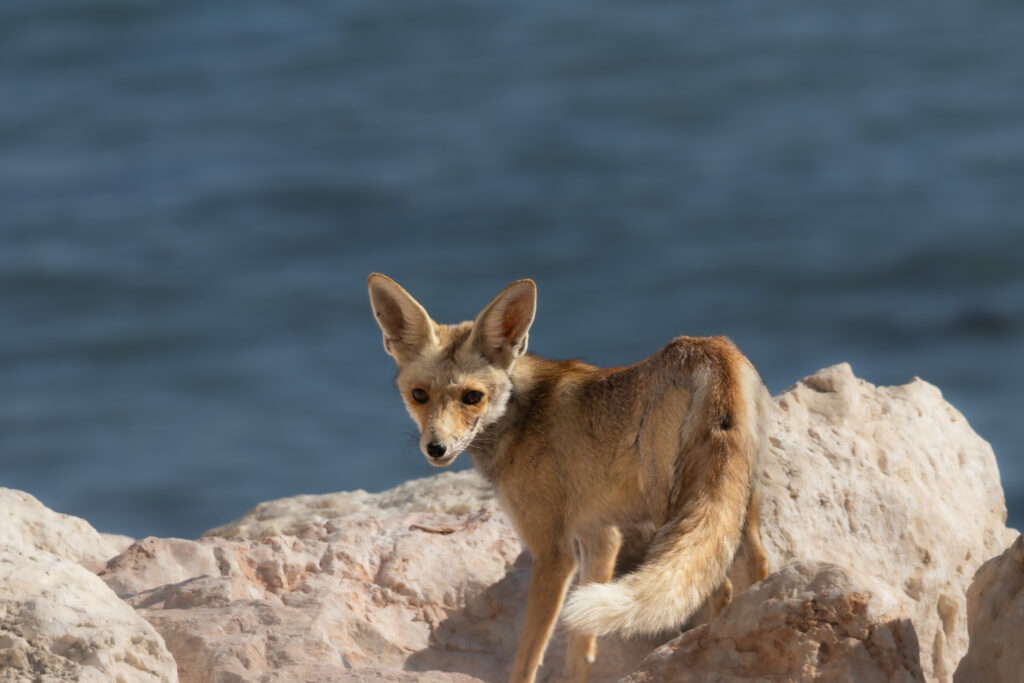
I've often encountered this phenomenon on my travels: whether it's a desert fox frozen like a statue, or a bird following me with its eyes. In biology, this behavior is far more than mere camouflage. It's a state of heightened information processing. Those who move are seen. Those who stand still visually disappear, gaining valuable seconds to precisely assess their situation. It's an active process: reading the environment, tensing the muscles, ready to explode yet still anchored in absolute stillness.
We humans, on the other hand, live in a time that no longer tolerates pausing. From goal to goal, from screen to screen, constantly in motion, but rarely truly present. We confuse activity with effectiveness, reacting blindly instead of perceiving. And so we lose touch with the moment and the situation.
Animals teach us the opposite: their stillness is not a retreat, but clarity. In nature, waiting doesn't mean delay, but conserving intelligence and energy, reading the situation, sensing the right moment. Stillness there is not a weakness, but a vital form of focus.
In our world, which demands constant action, this conscious stillness becomes a forgotten art: presence through silence. Those who pause step out of automatic reflexes. They don't just slow down—they change the playing field. In this stillness often lies greater agency than in constant activity.
Perhaps that's the crux of the matter: True strength doesn't arise from blind movement, but from awareness in stillness. Like the animal that remains fully alert in the tension of the moment – minimal in movement, maximal in perception.
Nature knows no standstill due to weakness, only due to wisdom. And this principle applies to the business world. In negotiations, in conflicts, in moments of uncertainty, we usually resort to attack or flight, both forms of speed. But the most effective reaction is often the third: conscious pause. Those who remain calm in the heat of a dispute, without freezing, defuse the pressure. They read the situation instead of being read by it. Those who stand still in the storm, without being swept away, see more clearly—the other person and themselves. True authority arises not from frantic resistance, but from centered stillness: rooted in the present, ready for the step that truly matters.
Learning from nature – not as a metaphor, but as a method.