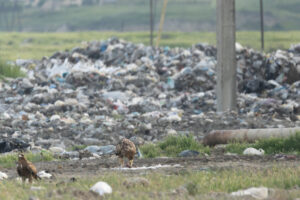
I was driving north from Baku and had deliberately turned off the highway. I drove slowly on the country road. There's always something going on at the roadside; that's where life unfolds, the kind you don't see when you're speeding by. Two birds of prey on the ground caught my eye. One was tearing at something, a piece of meat, a scrap. I stopped. I didn't know what was there. Only that there were birds of prey in this region, and so I was looking for them anyway. Through my binoculars, I got my first shock. The bird was standing in front of a huge pile of garbage. Only when I looked further back did I understand that the piles weren't random. It was a landfill. It was late afternoon, almost evening, the sun was setting. I drove slowly along the dirt road, black, full of potholes, beside the landfill. And to my great astonishment, I saw that birds lived there. Not just a few. Many, of different species.
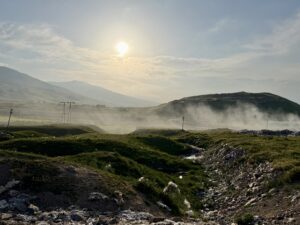
The landfill was burning. No open flame, just smoke billowing from the garbage. The stench didn't come from the waste alone, but mostly from the smoke, and it was almost unbearable. I had nothing with me. I tied a long-sleeved T-shirt over my mouth and nose, more improvisation than protection, just so I could take pictures at all. Nobody lingers here. Only the trucks that bring the garbage; no one else comes here. The road runs along the edge of the landfill; every now and then a car drives by, but nobody stops. Only the birds are here constantly. For them, this place isn't just an edge to be driven past. It's the center.
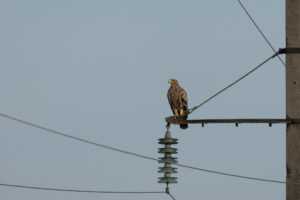
Above it all sat an eagle. A young imperial eagle, high on the crossbeam of a power pole, directly above the landfill. From there, he saw what I couldn't see from below: the entire field of waste and everything that moved within it. He perched on the metal, just above the glass insulator, where the current flows. On an unsecured pole like this, a bird of his size can die; one wing in the wrong place is all it takes. What drew him up was the same thing that drew the others down. The food was right there. The best place to see it was also the most dangerous.
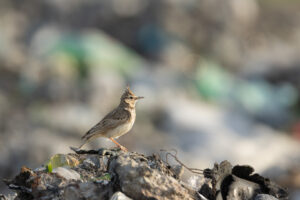
A crested lark stood on a clump of rubbish as if it were a stone. Among the plastic sheeting, scraps, and glass, the birds searched for food, hunched over and busily engaged, as if this were a field like any other.
They are here because the place feeds them. Where waste accumulates, mice, insects, and other food sources also gather in an abundance rarely found in natural landscapes. The smell of the organic remains carries far and attracts many species at once. But what nourishes them is also what threatens them. Birds can ingest plastic, glass, or other foreign matter along with their food. Added to this are pollutants and, if the landfill is burning, as it is here, smoke.
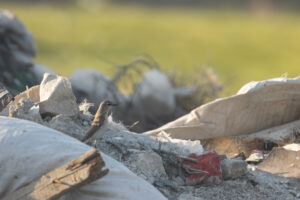
The next day I returned. It hadn't let me go. I knew how it smelled there, and yet I headed back because I had to see it again. Not for pretty pictures. To understand. How many there really are. How they endure it. And the one question I couldn't answer: How do you protect something that doesn't know it needs protection?.
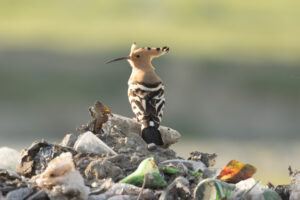
Before I left, I saw him again. A hoopoe, its crest raised, its plumage barred black and white, a bird that looks like it's from another time. It was standing on a pile of broken glass, green and red shards in the evening light. A beautiful bird, sharp edges. It was searching for food among the shards, calmly, practiced, as if this had always been its place. Perhaps it is now. Or perhaps it has always been here, and the trash was added later. I took the picture and returned to the road, where people drive by without stopping.